
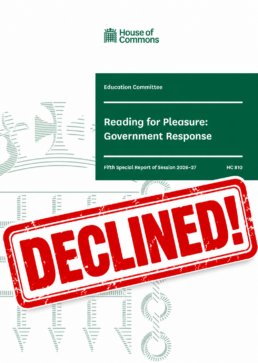
📚 A READING CRISIS DESERVES MORE THAN A ‘PARTIALLY ACCEPTED’ RESPONSE.
On Thursday 19th November 2026, the Government published its response to the Education Committee’s Reading for Pleasure report. Idon’t think it’s a coincidence that they released this reporton the same day that GTA VI dropped! Clearly, this was an attempt to bury bad news!
Having read the reponse in full, I can’t help but feel an overwhelming sense of disappointment at what represents a significant missed opportunity.
The Education Committee presented a compelling case for radical, sustained change in this country’s relationship with reading. Yet, in response, we are presented with page after page of ‘partially accepted’ and ‘declined’, with many responses pointing towards existing initiatives rather than committing to meaningful new action.
Consider some of the recommendations:
🟠 A National Reading Guarantee from birth to 18? Partially accepted.
🟠 A National Decade of Reading? Partially accepted.
🟠 Protected curriculum time for reading and discussion about books? Partially accepted.
🔴 A dedicated national Reading for Pleasure strategy? No commitment.
🔴 Statutory provision of school libraries? Declined.
🔴 Restoration of lost public library funding? Declined.
🔴 Additional guidance and resources to support author visits and literary partnerships? Declined.
Where is the ambition? Where is the urgency? Where is the long-term vision?
We are facing a generational decline in children’s enjoyment of reading. This is not a problem that can be solved by a single year of campaigning, a handful of initiatives or simply repackaging existing commitments.
It requires systemic change.
There are, of course, positives within the response. The commitment to giving fluency, comprehension and reading for pleasure greater prominence within the forthcoming national curriculum is particularly welcome.
But recognition without meaningful action will achieve very little.
If we are genuinely serious about transforming this country’s reading culture, we need:
📖 A sustained national strategy that extends beyond political and electoral cycles.
📖 Protected time for children to experience literature without the expectation of an assessed outcome.
📖 Properly resourced, accessible and vibrant school and public libraries.
📖 Sustained investment in developing teachers’ expertise in reading pedagogy, children’s literature and reading communities.
📖 The courage to critically examine whether our curriculum, assessment and accountability systems are contributing to the very problem we are trying to solve.
📖 A national understanding that developing a child who CAN read and developing a child who WANTS to read are equally important ambitions.
For too long, we have operated within an education system in which schools are held accountable for children’s reading attainment but merely encouraged to develop their enjoyment of reading. That imbalance needs addressing.
And this is categorically not a criticism of our schools or teachers. Across the country, extraordinary educators are working tirelessly to inspire a love of reading, often against a backdrop of financial pressures, curriculum demands and competing priorities. They deserve more than encouragement. They deserve the time, resources, expertise and systemic support to make it happen.
The National Year of Reading should have been the beginning of something much bigger, not the extent of our ambition. We need to stop treating reading for pleasure as a campaign and start treating it as a national commitment. Because the ultimate measure of a successful reading education should not simply be how well a child reads on the day they leave school, but the relationship they have with reading for the rest of their life.
A generational crisis requires a generational response. I’m not convinced this is it.
I’d love to hear the thoughts of fellow educators, school leaders, librarians, authors and others who care passionately about reading.
Have we missed a golden opportunity? And what would you have liked to see the Government commit to?
You can read the Government’s response in full here:
https://committees.parliament.uk/publications/55868/standard/pdf